Showing posts with label civil liberties. Show all posts

August 2, 2013

This week: No Ray Kelly for Homeland Security, and California prison strike


A criminal justice double header this week:

In theGrio, my thoughts on why Obama should NOT tap NYPD commissioner Ray Kelly for the head of Homeland Security (hint: racial profiling).  Click HERE for more.

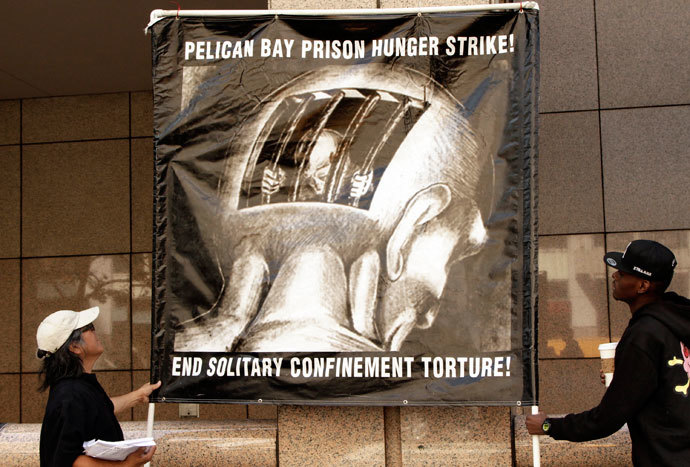
And in McClatchy-Tribune News Service, a look at the mass hunger strike taking place in California's prison system.  Click HERE for more.

July 23, 2012

Georgia wants to execute Warren Hill and violate the Constitution


Georgia is about to execute a mentally disabled man in violation of the U.S. Constitution.

Unless the U.S. Supreme Court intervenes, the state of Georgia will execute a man that everyone agrees is mentally retarded.  A state court determined that a decade ago.  The execution would violate the U.S. Constitution if carried out, but apparently that standard is not good enough for the Peach State.

Warren Lee Hill, Jr., who has an I.Q. of 70, is scheduled to die by lethal injection on July 23.  His original execution date of July 18 was postponed due to changes in the state’s execution drug protocol.  Georgia, which once used a three-drug cocktail, has opted for a single drug dosage of pentobarbital—a sedative used to put down dogs and cats that has been banned for export by the European Union.

On July 18, Texas used pentobarbital to execute Yokamon Hearn.  Hearn was a mentally impaired man who, according to his defense, suffered mental impairments due to his mother’s prenatal drinking, and abuse from his parents.

In his order denying relief to Hill, Superior Court Judge Thomas H. Wilson wrote that Hill meets the criteria of mental retardation by a preponderance of the evidence.  In Atkins v. Virginiathe Supreme Court  mandated the states to protect people with mental retardation because there is a “special risk of wrongful execution” because of their disabilities.

Writing for the majority in Atkins, Justice Stevens opined that the mentally disabled should not be executed because it provides no deterrent effect, and that such offenders are not culpable to deserve such a form of retribution.  He added that with reduced capacity, mentally retarded defendants face a risk of wrongful conviction. They are poor witnesses, may give less meaningful assistance to their lawyers, and their demeanor may give an impression that they lack remorse.

“Those mentally retarded persons who meet the law’s requirements for criminal responsibility should be tried and punished when they commit crimes,” Stevens wrote.  “Because of their disabilities in areas of reasoning, judgment, and control of their impulses, however, they do not act with the level of moral culpability that characterizes the most serious adult criminal conduct.  Moreover, their impairments can jeopardize the reliability and fairness of capital proceedings against mentally retarded defendants.”

However, Georgia sees things differently.  Georgia requires defendants to prove they have an intellectual disability beyond a reasonable doubt—the strictest standard in the nation.  And experts agree Georgia is an outlier, as the only state in the Union with such an unreasonably high burden of proof and an impossible standard to meet.  Yet, the state judge believes that Hill does not meet Georgia’s standard, and that Georgia’s standard does not violate the U.S. Constitution.

Many have already spoken out on this case.  Several jurors from the case said they would have sentenced Hill to life without parole if they had the option.  Former President Jimmy Carter and Rosalyn Carter called for clemency, and the victim’s family called for a commutation of his sentence.  Mental health advocacy groups, including the Georgia Council on Developmental Disabilities, the Arc of Georgia and the American Association on Intellectual and Developmental Disabilities (AAIDD) have called for a stay of Hill’s execution as well.

Further, the international community has voiced its opposition to the execution.  Christof Heyns—the UN special rapporteur on extrajudicial, summary or arbitrary executions—said Hill’s execution “would be a fatality in violation of international as well as domestic law.”

Georgia has a history of problems in its application of the death penalty, often making big mistakes by playing fast and loose with justice.  In 2005, the state of Georgia granted a posthumous pardon to Lena Baker.  A black maid who was executed in 1945 for killing a white man she said enslaved and beat her, Baker was the only woman executed in Georgia’s electric chair.  Her last words were "What I done, I did in self-defense, or I would have been killed myself ... I am ready to meet my God."

And last September—despite strong indications of innocence, an international outcry and a petition of 1 million signatures— Georgia sent a man named Troy Davis to his death.  The execution of Troy Davis, despite the absence of a murder weapon, physical evidence or DNA linking him to the crime, placed the spotlight on Georgia and the injustices of the death penalty.  This, in a state where five death row inmates have been exonerated.

And Georgia is in the spotlight once again, as it plans to execute Warren Hill, a mentally ill man.   And as the state decides to go it alone— flying in the face of the Constitution— the attention it receives is an embarrassment.

April 24, 2012

theGrio: Mitt Romney has a Robert Bork problem


I wrote a piece for theGrio on Robert Bork, the former judge, Supreme Court nominee and now adviser to GOP presidential candidate Mitt Romney.  Bork's extremist views on civil rights, women's rights and just about everything else raise a red flag.  Click HERE for more.

February 10, 2012

Reggie Clemons is Troy Davis


The case of Reggie Clemons represents everything that is wrong with the death penalty and the U.S. criminal justice system.


His case reminds us of Troy Davis, a black man who was executed by the state of Georgia in September, despite strong evidence of innocence, no physical evidence, another suspect and unreliable witnesses, not to mention worldwide protests.


In 1993, Clemons was sentenced to death in St. Louis, Missouri as an accomplice to the 1991 murder of Julie and Robin Kerry - two white women who plunged to their deaths off the Chain of Rocks Bridge into the Mississippi River. He was 19 at the time of the killings, with a clean record.


He was beaten by police, denied a lawyer, and coerced into making a false confession. As Amnesty International reported, there was no physical evidence linking Clemons to the murders. Even the prosecution admitted that Clemons did not murder the victims, nor did he plan the crime.


Two other young black men, Marlin Gray and Antonio Richardson, were sentenced to death along with Clemons. Gray was executed, and Richardson had his sentence reduced to life. Two sketchy eyewitnesses were essential to Clemons’ death conviction. Daniel Winfrey, a white co-defendant, pled guilty to a lesser offense in exchange for his testimony against the black defendants. Winfrey allegedly told a cellmate he would “say anything” to get a plea bargain, and “no one is going to believe a bunch of niggers.” He is now a free man on parole.


Meanwhile, Thomas Cummins, the victims’ cousin, originally confessed to killing the women, which he told police stemmed from an argument after he tried to have sex with Julie. Cummins also claimed he fell 90 feet off the bridge and swam to safety, which was unlikely given that he was dry and unscathed. Despite the inconsistencies in his statements, the charges against Cummins were dropped after he identified Clemons and the other suspects. Cummins received a $150,000 settlement in a police brutality suit.


Meanwhile, Clemons and Gray both claimed police brutality and coercion but were ignored. Clemons - who had been beaten by police and was ordered hospitalized by the judge at his arraignment - was coerced into confessing to rape. He did not confess to murder. And the audiotaped forced confession was admitted as evidence of his guilt.


This is where the problems for Reggie Clemons were only just beginning. To sum it up, he just couldn’t win, and the system seemed to conspire against him. His defense attorneys were unprepared for trial and neglectful, and the deck was stacked against him, as was the jury. The prosecutor, Assistant Circuit Attorney Nels Moss, who was disciplined by the court and had a pattern of misconduct, disproportionately excluded black prospective jurors, leaving a mostly white pro-death penalty jury in this heavily black city.


And then there was the rape kit and lab reports from one of the victims, buried in police headquarters for years, and never revealed at trial. One could reasonably assume that if that evidence had been helpful to his case, Moss would not have hidden it.


Police torture and false testimony, crooked prosecutors and a stacked jury, incompetent defense counsel and missing evidence. Let’s not forget raw racism. These are the key ingredients of a horrid dish called American justice. 


And sadly, this is why Reggie Clemons is facing execution. This is a prime example of what happens when criminal behavior in the police station and the courtroom sends an innocent man to his death. But unlike Troy Davis in Georgia, Cameron Todd Willingham, Ruben Cantu or Carlos DeLuna in Georgia, or Larry Griffin in Missouri, Reggie Clemons is still alive. There is still time to save him. We can fix this.


On the other hand, we cannot fix our system of capital punishment. According to the Death Penalty Information Center, since 1973, 140 innocent men and womenhave been freed from death row in 26 states, each spending an average of nearly 10 years in prison awaiting execution.

March 9, 2011

Rodney King beating 20 years later: Can't we all just get along?


From theGrio:

This week marks the twentieth anniversary of the Rodney King beating, an incident which shone the spotlight on police brutality and race relations in Los Angeles and throughout the United States.

On March 3, 1991, King -- who was driving with two of his friends in his white Hyundai -- was stopped by LAPD officers following a high-speed chase on the 210 freeway with the California Highway Patrol. King reportedly had been drinking with his friends. Ordered out of car, King was repeatedly beaten and kicked by officers Laurence Powell, Timothy Wind, Theodore Briseno and Stacey Koon. According to court records, after learning that King worked at Dodger Stadium, Powell said to King: "'We played a little ball tonight, didn't we Rodney? You know, we played a little ball, we played a little hardball tonight, we hit quite a few home runs. Yes, we played a little ball and you lost and we won.'"

King sustained serious internal injuries, including a broken cheekbone and a broken right ankle, and received 20 stitches, including five inside of his mouth. In his negligence claim against the city of Los Angeles, for which he later won $3.8 million, he also claimed he suffered "11 skull fractures, permanent brain damage, broken [bones and teeth], kidney damage [and] emotional and physical trauma."

The four officers would later claim self-defense, arguing that their lives were in danger from King, who they said was aggressive and was resisting arrest. Meanwhile, other police officers who were on the scene did nothing to stop the beating. What made this police beating incident different from many others was that it was caught on videotape -- by a bystander named George Holliday, a plumbing company manager. The tape showed that the officers clubbed King with 56 baton strokes, and kicks to the head and body.

The LAPD officers were charged but were later acquitted by a jury trial the following year. The acquittal led to the April 1992 Los Angeles riots, in which 55 people were killed, about 2,000 were injured and 12,000 arrested, with over $1 billion in property damage. In the midst of the riots King called for calm, asking in the now famous words, "People, I just want to say, you know, can we all get along?" The officers were subsequently tried in federal court on civil rights violations, where Powell and Koon were convicted and sentenced to 30 months each. Wind and Briseno were acquitted.

In the wake of the Rodney King beating, The Christopher Commission report was issued to conduct "a full and fair examination of the structure and operation of the LAPD," including its recruitment and training policies, citizen complaint system and internal disciplinary practices. The report found that a significant number of police officers used excessive force and ignored department guidelines. In addition, the complaint system was skewed against complainants. There was a breakdown in leadership on the force, a management problem, with a failure to deal with repeat offender officers who were often promoted and rewarded for their behavior.

"Testimony from a variety of witnesses depict the LAPD as an organization with practices and procedures that are conducive to discriminatory treatment and officer misconduct directed to members of minority groups," the report found. "Witnesses repeatedly told of LAPD officers verbally harassing minorities, detaining African-American and Latino men who fit certain generalized descriptions of minorities, employing unnecessarily invasive or humiliating tactics in minority neighborhoods and using excessive force." Police officers of color, the Christopher Commission found, were also susceptible to racist slurs, racially-motivated behavior and discriminatory treatment, which was attributed to white dominance in LAPD managerial positions. In light of these findings, the Commission recommended the resignation of LAPD police chief Daryl Gates.

The LAPD's reputation was further damaged in the late 1990s by the corruption scandal involving the Community Resources Against Street Hoodlums (CRASH) anti-gang unit of the LAPD's Rampart Division. Over 70 officers were implicated of brutality, misconduct and corruption. At least three officers in the unit were found to be on the payroll of Death Row Records boss and convicted felon Marion "Suge" Knight, who is affiliated with the Bloods gang. The officers were implicated in the drive-by shooting murder of rapper Christopher "Biggie Smalls" Wallace, (a.k.a. The Notorious B.I.G.). The scandal led to over 140 civil lawsuits, with settlement costs of over $125 million. The report of the Rampart Review Panel noted a sense of insularity in the CRASH unit. This created an "us versus them" mentality towards the community, and an "ends justifies the means" attitude that led to abuses of authority, such as the planting of evidence, unjustifiable beatings and shootings, bank robbery and drug dealing. "Community policing -- which must be at the heart of the Department's efforts to reestablish its credibility with the public -- remains more a slogan than reality. And ethics remains almost an afterthought in the training of the City's police officers," according to the report.

Click HERE for more.

August 15, 2010

Repeal of 14th Amendment is un-American

From The Progressive:

The call by some conservative lawmakers to repeal the 14th Amendment represents the worst of America.At a time of economic hardship when we should be uniting people and making them whole, such an idea will only serve to sow the seeds of hate and division.

Sen. Lindsey Graham, R-S.C., — who does not think that the children of undocumented immigrants should automatically become citizens — has proposed a piece of legislation to begin repealing the amendment. And Sen. Jon Kyl, R-Ariz., has called for hearings into the matter.

Adopted on July 9, 1868, and championed by the so-called “Radical Republicans” in Congress, the Fourteenth Amendment to the U.S. Constitution grants citizenship as a birthright. The citizenship clause states: “All persons born or naturalized in the United States, and subject to the jurisdiction thereof, are citizens of the United States and of the state wherein they reside. No state shall make or enforce any law which shall abridge the privileges or immunities of citizens of the United States; nor shall any state deprive any person of life, liberty, or property, without due process of law; nor deny to any person within its jurisdiction the equal protection of the laws.”

This clause was important because it thwarted attempts by Southern states to deny citizenships to former slaves.

But little of these details on the history or the importance of the 14th Amendment mean much to those who would repeal it. Rather, they only seem to care about scoring political points.

And while they could develop positive solutions in the area of immigration reform, they choose to divide people along lines of color, race, ethnicity, class, language and national origin.

In the current economic recession, people are in despair and are looking for scapegoats. People blame immigrants — particularly Latinos and undocumented workers — for losing their jobs and livelihoods. Patriot and militia groups patrol the border and harass and threaten Latinos. And while hate groups and the tea party movement exploit these insecurities, some unscrupulous lawmakers are trying to codify this hatred.

This is such a bad idea that even Lou Dobbs disagrees with it.

“I part ways with the senators on that because I believe the 14th Amendment, particularly in its due process and equal protection clauses, is so important,” Dobbs said. “It lays the foundation for the entire Bill of Rights being applied to the states.”

Giving away the 14th Amendment is giving up on America. Citizenship should remain a birthright in this nation of immigrants. But that right was a secured only by fighting a bloody Civil War and overcoming a brutal legacy of slavery.

Sadly, some people want us to turn the clock back to the antebellum days.

February 27, 2008

J. Edgar Hoover, Enemy of the People

By David A. Love
Published by The Black Commentator
February 28, 2008

The New York Times reported that according to a newly declassified document, FBI Director J. Edgar Hoover, in 1950, planned to suspend habeas corpus and permanently imprison 12,000 “disloyal” American citizens in military prisons. Under Hoover’s proposal, the mass arrests of “all individuals potentially dangerous to national security” would be carried out under “a master warrant attached to a list of names” provided by the FBI. Hoover saw the arrests necessary to “protect the country against treason, espionage and sabotage.”

Hoover was guilty of projection when he called Dr. Martin Luther King, Jr., “the most dangerous man in America, and a moral degenerate.” With his one-man war on progressive social movements, the civil rights movement and African American leadership, antiwar activists, and radical groups, he had been the greatest threat to democracy until the current occupants of the White House came to power. Under his COINTELPRO program, devised to “prevent the rise of a black messiah,” Dr. King, Malcolm X and other leaders were assassinated or otherwise neutralized, members of leftwing political groups framed and imprisoned, and their causes denigrated and defamed. Even today, the appalling COINTELPRO legacy lives on, as eight former Black Panthers were arrested for the 1971 killing of a San Francisco police officer, trumped up charges based on evidence obtained through torture. Perhaps we will never know how much better America would have been without J. Edgar Hoover.

Clearly, Hoover and his ilk represent the worst in America - an aversion to the rule of law, secret government, spying on citizens, condoning torture, squelching democratic movements and other fascistic tendencies. So, why do we allow a federal building to take the name of such a loathsome individual?

Of course, I speak of the J. Edgar Hoover Building, the headquarters of the FBI in Washington, DC. Perhaps it can be argued that it really doesn’t matter, Hoover left us a long time ago and can no longer harm us, and having a building named after him is mere symbolism in any case.

But it does matter, primarily because the U.S. has not learned lessons from its past. Although Hoover died in 1972, he lives on in an antidemocratic mindset that pushes the nation towards fascistic behavior. “Enhanced interrogation techniques,” or torture, is viewed as an acceptable weapon in America’s war on terror. Terror suspects are kidnapped and imprisoned indefinitely, without charges, without evidence and without trial. Citizens are secretly monitored. That we have allowed the Bush administration to engage in these activities is proof that we have not come to terms with the shameful Hoover legacy. Once we erase Hoover’s name from the building, and revoke all posthumous honors bestowed upon him, then we can begin to repair the damage done by this petty American dictator and his ideological heirs.

November 14, 2007

"Less Safe, Less Free: Why America Is Losing the War on Terror," By David Cole & Jules Lobel


A Review By David A. Love
Published by The Black Commentator
November 15, 2007

“Democracies die behind closed doors.”

–Judge Damon Keith, 2002, declaring unconstitutional, Attorney General Ashcroft’s policy of closing to the public all immigration proceedings involving persons of interest to the 9/11 investigation

“I don’t believe in Al Qaeda; I don’t believe in the boogie man, the Loch Ness monster. I don’t believe you, because you all said the same s*** about the Black Panther Party.”

-Mos Def

In George Orwell’s novel 1984, the superpower state of Oceania — a totalitarian regime marked by the constant surveillance of its people — is in a state of perpetual war with Eurasia and Eastasia. Big Brother, the leader of Oceania’s repressive regime, tells his citizens that the nation is better than its enemies, which at any given time may be Eurasia, or Eastasia, or both, and that it is winning the war against its rivals. Meanwhile, the people of Oceania really do not know for certain that Oceania is winning the war, or that the war actually exists, or even that Eurasia and Eastasia actually exist.

America’s so-called war on terror reminds me of this Orwellian concept of perpetual war. One can make the argument that both are used to manipulate the citizenry through secrecy and coercion, justify a waste of precious resources, and rationalize the purging of basic civil liberties.

A new book by Georgetown law professor, David Cole, and University of Pittsburgh law professor and Center for Constitutional Rights, vice president Jules Lobel, provides a critique of America’s post-9/11 war on terror. Less Safe, Less Free: Why America Is Losing the War on Terror (The New Press, 326 pp.) suggests that this war has been an abysmal failure. The authors focus their attention on the cornerstone of the Bush administration’s antiterrorism efforts, the preventive paradigm.

Under the preventive paradigm, nations are attacked and suspects are kidnapped, tortured, detained and prosecuted, not based upon what they have done, but on what they could do in the future. Under this warped logic, the usual cost and benefit analysis is eschewed on the grounds that the stakes are too catastrophic. In other words, as its proponents would argue, we must do whatever is necessary in order to prevent deadly terrorist attacks and fight the people who commit them. Decisions to take action are the result of a warped calculation based on hunches, driven by suspicion and hysteria, and rife with abuse.

But perhaps the most troubling aspect of the preventive paradigm is its disdain for the rule of law. The legal process, both domestic and international, is viewed not merely as passé and an inconvenience, but a strategy for the weak and an anathema. Americans are subjected to illegal wiretaps. People are held indefinitely, based on questionable evidence, evidence obtained through torture, or no evidence at all. They are deemed terrorists because they have a certain political or religious affiliation, or belong to a certain racial or ethnic group, or because the president says so.

Supporters of the preventive paradigm cannot point to any successes as a justification for its coercive methods and the elimination of the rule of law. The vast majority of the detainees at Guantanamo (95 percent) are not members of the Taliban or al Qaeda, and draconian immigration reforms have not unearthed a single terrorist. And almost no terrorists have been brought to justice.

However, this misguided strategy has cost the lives of countless thousands in Iraq, thwarted legitimate antiterrorism efforts, and encouraged the spread of more terrorism. The international community distrusts the United States, and the Muslim world resents and hates America for its interventionism and aggression in the Mideast, and justifiably so. Meanwhile, as America embraces antidemocratic principles in the war on terror, it provides cover to other repressive regimes who wish to do the same.

The authors propose constructive solutions to undoing the harm created by preventive war, including the respect for the rule of law and international human rights legal principles within U.S. borders, the elimination of overseas military bases, the use of diplomacy rather than war and coercion, and international cooperation. Further, the authors call for the U.S. to embrace the International Criminal Court, which Bush has sought to undermine by not participating in it, and seeking to make American citizens immune from prosecution.

Professors Cole and Lobel perform a valuable service by deconstructing and demystifying one of the most deplorable chapters in American history, as it is occurring, and suggesting positive solutions. Less Safe, Less Free is required reading for critics of the war on terror and the Iraq War, lovers of civil liberties and human rights, and those who are concerned about the monster this country has become.

Copyright © 2007 by David A. Love