December 29, 2007

Tasers deadly, should be banned


By David A. Love
Progressive Media Project
December 28, 2007

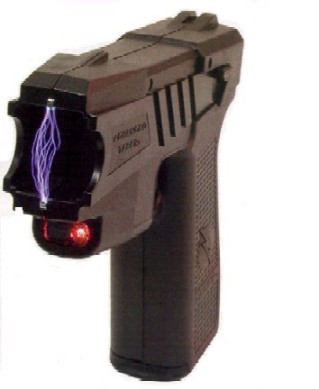
The Taser is a deadly weapon and should be banned.

A Taser, also known as a stun gun, is a hand-held device that fires two jumper-cable-type probes that attach to a person up to 35 feet away. It sends a charge of 50,000 volts to the body and demobilizes its subject.

The weapon is used by nearly 12,000 of the 18,000 law-enforcement agencies in America, according to Thomas P. Smith, chairman of the board and co-founder of the manufacturer Taser International, in a recent interview with NPR's Diane Rehm. Of these, 4,000 agencies provide a Taser for every officer, he said.

According to Amnesty International, 291 people have been killed by police Tasers in the United States since 2001, though the manufacturer denies there is a direct link. Amnesty is concerned that Tasers are being used as a routine tool of law enforcement rather than as a weapon of last resort. It says the vast majority of people killed by Tasers were unarmed and posed no danger to police.


"We notice that a lot of the people who are shot with this weapon and subsequently die are mentally ill, are under the influence of narcotics, alcohol or illicit drugs," says Dalia Hashad, director of Amnesty International USA's domestic human rights program. "Many of the people who have problems seem to be elderly or very young, and that really raised some important concerns for us."

What's more, police often use the weapon recklessly. Officers subjected 92 people to between three and 21 shocks. One man died after being electro-shocked for 57 continuous seconds.

The rate of death appears to be increasing. In one week in November alone, four people died in the United States after being hit by Tasers.

Canada has had its problems with the controversial weapon as well. In September, Claudio Castagnetta, a 32-year-old Italian, died in a Quebec City jail after he was jolted with a Taser while allegedly having a psychotic episode. In October, a 40-year-old Robert Dziekanski, who spoke only Polish, died after being shocked twice by a Taser at Vancouver International Airport. And in November, Howard Hyde, a 45-year-old paranoid schizophrenic man, died in a Dartmouth, Nova Scotia, jail 30 hours after being Tasered by police.

This prompted the Royal Canadian Mounted Police to announce a shift in policy regarding Tasers on Dec. 14. The new policy severely restricts their use.

But no such restriction, much less a ban, is in effect in the United States.

Last month, the U.N. Committee on Torture said that the use of Tasers "constituted a form of torture."

Police cannot fight crime at the expense of our human rights or our lives. Tasers should be removed from all police stations in the country.

Jumper cables should be used on cars, not on people.

December 20, 2007

Reverend Pinkney Arrested For Exercising Free Speech, On Hunger Strike In Berrien County Jail


By David A. Love and Larry Pinkney
BC Editorial Board
Published by The Black Commentator
December 20, 2007

In a series of commentaries in recent months, BlackCommentator.com has reported on the story of Reverend Edward Pinkney. Rev. Pinkney, a Black community leader and activist, has led the fight against official corruption and corporate greed in his impoverished and predominantly Black community of Benton Harbor, Michigan.

In an effort to stop the giveaway of Benton Harbor’s prime waterfront property to the Whirlpool Corporation—which plans to build the $750 million to $1 billion Harbor Shores, a resort complete with a marina, golf course, hotels and luxury housing units, none of which will provide any benefit to Benton Harbor’s residents—Pinkney led a successful election effort to unseat the city’s most influential powerbroker. A local judge threw out the election, and was subsequently rewarded by President Bush with a seat on the federal bench.

In retaliation for the recall effort, Pinkney was charged with voter fraud under an unjust, overly broad state law and found guilty by an all-White jury. He was placed on probation and placed under house arrest. His appeal for a new trial was denied. For a detailed analysis, see Larry Pinkney’s May 10, 2007 commentary entitled, Benton Harbor 2007: A Case Study of State Sanctioned Suppression of Voting Rights, and David A. Love’s December 13, 2007 commentary entitled, Reverend Pinkney’s Fight Against Racism, Gangsterism and Land Stealing.

On December 13, 2007, former Representative Cynthia McKinney (D-Georgia), a Green Party presidential candidate, visited Benton Harbor to show support for Rev. Pinkney. The next day, Judge Alfred Butzbaugh issued an arrest warrant for Pinkney on the grounds that Pinkney violated his probation by engaging in “assaultive, abusive, defamatory, demeaning, harassing, violent, threatening, or intimidating behavior.” At issue was an article in the November/December issue of The People’s Tribune, in which Rev. Pinkney stated “We must fight for justice for all anytime you have a Judge like Alfred Butzbaugh, who is a racist. It took over 53 days to render a fifth-grade decision denying me a new trial.” Pinkney also said “In my motion for a new trial, I argued that I was charged but never arraigned, nor did I receive due process by the dumb Judge and prosecutor.” He added: “I support the constitution of the United States and the State of Michigan; we are still waiting on this racist corrupt judge to do the same. Judge Butzbaugh has failed the people, the community, his duties and his office.” Neither Pinkney nor his counsel were aware of such terms to his probation.

Rev. Pinkney was arrested by sheriff’s deputies and locked up in the Berrien County Jail in neighboring St. Joseph. And his computer was confiscated. His supporters have endorsed a petition protesting the stolen Benton Harbor election and Pinkney’s false prosecution. They are calling for clemency from Governor Granholm, and a boycott of Whirlpool products.

In the meantime, Rev. Pinkney is on a hunger strike. He is taking only liquids. In a statement, former Rep. McKinney said the following: “We received a tremendous reception in Benton Harbor, Michigan--a majority black community that is fighting for its survival against powerful corporate interests that want to own its pristine beachfront land. Reverend Edward Pinkney has been a stalwart fighter for justice in the community and is leading its resistance to these powerful corporate interests. I went to Benton Harbor to support Reverend Pinkney and the people of Benton Harbor in their struggle for self-determination. At this meeting, it was clear that Reverend Pinkney had succeeded in bringing whites and blacks together in this fight for justice. And we know that powerful interests view that as a no-no. Unfortunately, today, the day after our wonderful rally with the residents, Reverend Pinkney was picked up by the police for allegedly violating the terms of his parole to not make ‘inflammatory statements.’”

Rev. Pinkney has been punished twice, once for fighting against powerful corporate interests— and using the democratic process to unseat their primary water boy— and a second time for using his First Amendment right to free speech by criticizing those who have committed a grave injustice against him.

The team of attorney’s representing Rev. Pinkney believes they have a good first amendment case. The National Lawyers Guild team will challenge the arrest, challenge the terms of the probation and ask the court to modify the conditions of probation at a hearing set for 4pm ET today (Thursday, December 20). Hugh M. Davis, one member the three-lawyer Pinkney legal team told BC they would argue in court that the seizing of Pinkney’s computer and prohibition of the use of a cell phone was illegal. Additionally they will argue that the terms of condition 15 of the probation document are overbroad and vague. The National Lawyers Guild team is hoping to get Pinkney released on bail while awaiting an appeal of the case.

The case of Rev. Pinkney is part of a lengthy ongoing struggle in Benton Harbor. Rev. Pinkney and the Black community of Benton Harbor are not receiving justice, and "justice delayed is justice denied" to Pinkney and the entire Black community of Benton Harbor.

Further, it should be noted that what is occurring in Benton Harbor with Rev. Pinkney and the Black community there is precisely what is taking place on assorted levels throughout the U.S., e.g. the Jena 6, the San Francisco 8, the officially admitted Black torture victims of the Chicago police, etc. And there are Benton Harbors across the nation, as Black, Brown and poor communities are displaced and decimated by gentrification and corporate greed, and in the case of New Orleans, eliminated through official neglect.

For those who believe it cannot, will not happen to them, the suppression of Rev. Pinkney's free speech rights jeopardizes the free speech rights of all Americans, particularly those of Black political activists and other people of color. At a time when what you say can land you in jail, this suppression of Rev. Pinkney and the Black community has a chilling effect upon the exercising of one's constitutional rights.

BC readers should contact Rep. John Conyers to let him know that they want justice for Rev. Pinkney:

Rep. John Conyers
669 Federal Building
231 W. Lafayette
Detroit, MI 48226
(313) 961-5670
(313) 226-2085 Fax

2426 Rayburn Building
Washington, DC 20515
(202) 225-5126
(202) 225-0072 Fax

2615 W. Jefferson
Trenton, MI 48183
(734) 675-4084
(734) 675-4218 Fax

Email Mr. Conyers: John.Conyers@mail.house.gov

December 13, 2007

Reverend Pinkney’s Fight Against Racism, Gangsterism and Land Stealing


By David A. Love
Published by The Black Commentator
December 13, 2007

New Development:

Reverend Edward Pinkney Jailed for Speaking Out

At approximately 1:30 pm Friday, December 14, 2007 Eastern time the Sheriff's Department in Berrien County Michigan arrested Rev. Edward Pinkney and took him to the Berrien County Jail in St. Joseph (the adjoining township to Benton Harbor, Michigan).

The sheriff also seized/confiscated Rev. Pinkney's computer when he was arrested.

Pinkney's wife Dorothy tells BlackCommentator.com the sheriff's deputies presented a bench warrant that stated Pinkney was being arrested for violating the 15th condition of his probation by writing the following words about a white Berrien judge in an article published in the Peoples Tribune newspaper.

"The corruption and the deceitfulness continues in Berrien County Courthouse. Judge Butzbaugh has violated his oath. I support the constitution of the United States and the State of Michigan; we are still waiting on this racist corrupt judge to do the same. Judge Butzbaugh has failed the people, the community, his duties and his office."

Click here to read the entire article.

Click here to view the arrest warrant acquired by BC.

Dorothy Pinkney tells BC her husband and his lawyer were completely unaware of any condition of the probation prohibiting "inflammatory behavior". Ms. Pinkney also tells BC that her husband feels he has the authorities in Benton Harbor, Michigan exactly where he wants them and the situation is in his favor because there is now undeniable proof of the existence of the injustice he has been protesting.

BC will update this report if new information is received.

What follows is more about the Pinkney case in the Color of Law column by David A. Love that was published on Thursday, December 13, 2007.

-0-


In Benton Harbor, Michigan, the injustice against Rev. Edward Pinkney continues.

An outspoken leader in the fight against racial injustice, poverty, corruption and corporate greed, Rev. Pinkney was sentenced to jail by an all White jury for voter fraud. His crime was leading a successful effort to unseat a city powerbroker, and resisting corporate development of his poor Black community. In a May 10, 2007 commentary, Benton Harbor 2007: A Case Study of State Sanctioned Suppression of Voting Rights, Black Commentator editorial board member Larry Pinkney (no relation) sets the stage by providing an insightful analysis of the situation in Benton Harbor.

Benton Harbor is a mostly poor (90 percent), mostly unemployed (70 percent) and mostly Black (94 percent) town of 11,000 people, located 100 miles east of Chicago. In fact, it is the poorest place in Michigan, and was called “the worst place to live in the nation” by Money magazine in 1989. Today, foreclosures abound and families are being decimated in Benton Harbor, while its residents are intimidated by police brutality and controlled by an unfair criminal justice system.

At the same time, Benton Harbor rests on prime waterfront property on Lake Michigan, adjacent to the predominantly White and affluent town of St. Joseph, home of the Whirlpool Corporation, the largest company in the area. Both communities are located in Berrien County, Michigan, which is less than 16 percent Black and has transitioned from an industrial economy to a tourist, service and real estate economy. Whirlpool has had machinations regarding its poor, isolated and economically depressed Black neighbor. It bought 465 acres of Benton Harbor’s prime real estate for $1 million - a modern-day equivalent of beads and trinkets - in order to pave the way for a $750 million to $1 billion private development project called Harbor Shores. The resort development will include two hotels, 880 luxury housing units, a marina and a Jack Nicklaus golf course. The project is of no benefit to the predominantly Black Benton Harbor residents. Pinkney and his organization, BANCO (Black Autonomy Network Community Organization) waged a recall election battle in 2005 to unseat Glen Yarborough, the powerful City Commissioner who was instrumental in making the land steal, or rather, land deal, happen.

Yarborough lost by 54 votes. A local judge, Hon. Paul Maloney, said there was fraud, threw out the election and ordered a new one, in which Yarborough won by 40 votes and was reinstated.

Maloney, who, as an election commissioner had voted against authorizing the language in BANCO’s recall petition, and had alleged ties to the Harbor Shores project, should have recused himself. But President Bush rewarded Maloney with a seat on the federal bench in the Western District of Michigan. This makes sense, given the energy spent by the Bush Justice Department on the manufactured issue of voter fraud - a pretext for the elimination of voting rights for Black, Brown and poor people, in order to facilitate Republican electoral victories across the nation.

Meanwhile, Yarborough sought payback. Pinkney was arrested and charged with voter fraud, amid sketchy allegations that Pinkney paid voters to vote against Yarborough, and that Pinkney handled absentee ballots. The prosecutor made use of a 1995 state law that makes it a felony to handle an absentee ballot of a person not a family member, even without evidence of ballot tampering or criminal intent. Pinkney provided poor Benton Harbor residents with address labels and postage stamps, but asserted that he did not handle the ballots.

Pinkney’s first trial in March, 2006, had two Black jurors. Witnesses were allegedly intimidated. There was a hung jury on all five counts against him. The prosecution called for another trial. This time, the National Lawyers Guild provided Pinkney’s defense. The second jury was all White, not surprising, given the county’s history of excluding African Americans from juries, a condition Rev. Pinkney spoke against for years. On March 21, 2007, the jury found him guilty, and he was sentenced to a year in jail and five years probation. He was placed under house arrest.

The selective prosecution of Black men is nothing new in America. Nor is the targeting of truth tellers and change agents. As hate crimes go unpunished, and as politicians and lawmakers commit criminal offenses against humanity, with impunity and without penalty, and pay no price for making deceitful decisions that cost thousands of lives, the Reverend Edward Pinkneys among us are fair game for prosecutors with lots of spare time, warped priorities, secrets to hide and interests to protect.

And surely, they believe that a community leader who fights against poverty and racial injustice, exposes corruption and unseats the powerful, poses a great threat to the status quo and must be silenced. This gives the impression, firmly grounded in reality, that this is not our justice system. “There is a problem here,” says Rev. Pinkney. “They are like gangsters here. They’re pushing them out of the community.”

Although it is easy to conclude that hicktown justice is limited to the deep South, one could say that Benton Harbor and Berrien County, Michigan are little more than Jena, Louisiana North. The case of Rev. Pinkney is proof that these things still happen, and the struggle continues. His fight is everyone’s fight, and how the story ends is up to ordinary, everyday people. Rev. Pinkney deserves clemency from the Governor of Michigan, and must be made whole for the injustices perpetrated against him. And Whirlpool products--including Maytag, KitchenAid, Magic Chef, Amana, Jenn-Air, Gladiator, GarageWorks, Inglis, Estate, Roper, Acros, Supermatic, Bauknecht, Brastemp, Consul, and Eslabon de Lujo - deserve a boycott by the public.

Copyright © 2007 By David A. Love

December 10, 2007

Hanging Hate: Backlash against the Jena Six case sparks an epidemic of public nooses


By David A. Love
Published by In These Times
January 2008

The noose, that symbol of American racism associated with the Jim Crow South, is making a comeback.

Following the notorious Jena, La., incident, a rash of noose-related hate crimes has surfaced around the country, at times in the unlikeliest of places. These cases are not aberrations, but part of an endemic problem.

On Oct. 9, 2007, in New York City, a noose was found hanging from the office door of a black professor at Columbia University Teachers College. On Oct. 10, an NYPD officer found a noose hanging over his locker. On Oct. 11, a noose was found hanging from a light pole in front of a post office near Ground Zero. On Oct. 22, a noose was sent to a high school principal, a black woman, in Brooklyn.

For African Americans, the noose symbolizes racial intimidation, violence and death—and with good reason. “The noose is among the most repugnant of all racist symbols because it is itself an instrument of violence,” noted Judge Robert L. Carter, a black federal district judge, in Williams v. New York City Housing Authority. In this 2001 employment discrimination case, African-American public employees were subjected to a hostile work environment, including the hanging of a noose.

Lynching has been America’s own form of domestic terrorism, columnist George Curry wrote recently in the Philadelphia Inquirer: “Far from being merely a prank, the hanging of nooses harks back to a shameful period in American history. It was not until 1952 that the United States went a whole year without a single lynching.”

Mark Potok, a staff director at the Southern Poverty Law Center, which tracks hate crimes and hate groups, thinks the current noose hangings are a reaction to Jena. “What the nooses represent is a wider and deeper backlash by whites than people recognize,” he says. “White people think the events in Jena were whitewashed by an evil and politically correct press.”

To track these hate crimes, DiversityInc magazine has initiated “Noose Watch,” which catalogues incidents of what it calls a “dangerous racist trend.” As of Dec. 5, it had collected information on 61 incidents that have occurred since the beginning of 2006. (The New York Times reports that 50 to 60 noose incidents have occurred since the large Sept. 20, 2007 rally in Jena) Most recently:

  • On Nov. 20, a city employee in Slidell, La., was fired for allegedly hanging a noose at a job site a few days prior.
  • On Nov. 13, a college student in Orangeburg, S.C., was arrested for hanging a noose in a classroom.
  • On Nov. 8, in Beekman, La., high school students discovered a raccoon hanging from a noose on their school’s flagpole.
  • On Oct. 30, a black mannequin with a noose tied around its neck was found in a county landfill building in Sacramento, Calif.
  • On Oct. 24, a noose was placed around the neck of a bronze statue of Tupac Shakur in Atlanta.
  • On Oct. 15, a housekeeper at Allegheny General Hospital in Pittsburgh, Pa., found a noose hanging in a 10th floor hospital room.
  • On Oct. 4, a black Verizon employee in Cranberry, Pa., found a doll with a noose tied around its neck, along with a note saying that she did not deserve her promotion.
  • On Oct. 1, at a construction site in Philadelphia, Pa., a white construction worker held a noose in front of a black co-worker and allegedly said he “wanted to hang someone.”
  • In October 2007, a noose was found hanging from the exit of a Home Depot store under construction in South Elgin, Ill., along with racist graffiti.
  • On Sept. 28, a noose was found in the men’s bathroom of the Hempstead, Long Island, police department.
  • On Sept. 20, two men were arrested in Alexandria, La., for having nooses in the back of their pickup truck, only hours after an anti-racism march in nearby Jena.

According to the Southern Poverty Law Center, the number of hate groups in the United States shot up from 602 to 844 between 2000 and 2006—an increase of 40 percent. The group also found that, based on 2005 Department of Justice data, about 191,000 hate-crime incidents are reported each year. The U.S. Equal Employment Opportunity Commission is handling an increasing number of noose cases alone: 24 since 2001. The number of reported workplace racial harassment cases increased from 3,075 in 1991 to 6,000 in 2006.

“The display of nooses does occur anywhere,” says Lewis Steel, a civil rights attorney at Outten & Golden in New York City. “African Americans who are exposed to this are infuriated by it. It rubs a nerve, whereas with white people it is just not in their experience.”

Steel is representing black and Latino employees in a lawsuit against the New York City Parks Department for racial discrimination and practices—including multiple displays of nooses on city property. He says that combating these incidents in the employment context depends to a large extent on the leadership of the employer.

“Certainly when we originally started the Parks Department case, [former New York City Parks Commissioner Henry] Stern viewed the display of nooses as silly,” Steel says. “He did not send a memo around, and no action was really taken against those who displayed them.”

Similarly, Reed Walters, the district attorney of LaSalle Parish, La., who prosecuted the Jena Six black teens for a schoolyard brawl with a white classmate, reacted to the hanging of the nooses at Jena High School by telling black students they were making too much of the “prank.”

Many black Americans think government officials are treating these noose incidents too lightly.

On Nov. 3, hundreds of people marched in Charleston, W.V., in support of Megan Williams, a 20-year-old black woman whom authorities say was kidnapped, tortured, beaten and raped by six white men and women in a trailer over the course of a week. Williams’ captors also allegedly forced her to eat rat, dog and human feces, and placed a noose around her neck. The six suspects, who were arrested and charged with kidnapping, sexual assault, malicious wounding and battery, have not been charged with hate crimes.

“They just kept saying, ‘This is what we do to niggers down here,’” Williams told the Associated Press.

On Nov. 16, thousands of community activists, led by the Rev. Al Sharpton, marched at the U.S. Department of Justice demanding that the federal government more vigorously prosecute crimes of racial violence.

“When you hang up a noose, it’s no joke to us,” said Sharpton at the march. “Every noose that’s hung should be prosecuted by the law. And we’re going to demand that today.” According to Sharpton, the federal government has relinquished its responsibility to protect civil rights by relying on states to address hate crimes, something he characterized as a “revival of states’ rights.”

In response to the march, Attorney General Michael Mukasey issued this statement: “In recent months, there have been reports of nooses and other symbols of racial and religious hate appearing in schools, workplaces and neighborhoods across the country. These symbols of hate have no place in our great country. … Although there are limitations and challenges in bringing successful hate crimes prosecutions, the department takes each case seriously and is prepared to vindicate the rights of the victims when prosecution is warranted by the facts and by federal law.”

Sen. Hillary Clinton (D-NY) has said that “for too long, the Department of Justice failed to confront the serious questions of injustice, inequality and intolerance raised by the troubling events in Jena.” She advocates restoring professionalism to the Civil Rights Division of the Department of Justice, and calls for strengthening the hate crimes laws and voting laws.

In a letter to Mukasey, presidential candidate Sen. Barack Obama (D-Ill.) wrote, “Unfortunately, this administration—and your predecessors as attorney general—have a poor track record in the area of investigating discrimination against racial minorities, while inexplicably focusing resources on a few, exceptional cases involving white victims.”

Meanwhile, Steel, who has used the legal system to wage the fight against noose-related hate crimes, thinks that community organizing is needed to get the attention of people in power and bring about change.

“There is a real connection between community organizing and leadership. This kind of conduct … is really despicable, so you hope the community should protest against this type of thing. It is hateful and it is stomach turning. You want to see communities organizing so this type of thing doesn’t happen again.”

But why are these racially motivated crimes on the rise at this point in time? Potok suggests that the recent noose incidents reflect not a fringe phenomenon, but a major social problem. “We’re looking at an upsurge in racial nationalism,” says Potok. “What’s going on is a serious backlash against globalization. You have a certain level of economic rage that provides fertile ground for these groups.” He says that with more people of color immigrating to the country, “whites are angry and uneasy.”

According to Potok, these whites who are scapegoating think, “Our country is being stolen from us. The country my white Christian forefathers built is being taken away.” But on Democracy Now!, Malik Shabazz, a member of Black Lawyers for Justice, said: “The hanging of nooses is a sign that there [could] be real bodies under those nooses very soon.”

December 6, 2007

Mumia Abu-Jamal: Evidence of Innocence and an Unfair Trial


By David A. Love
Published by The Black Commentator
COVER STORY - December 6, 2007


[The following are remarks made at a December 4, 2007 press conference held in Philadelphia by The International Concerned Friends and Family of Mumia Abu-Jamal (ICFFMAJ), and Journalists for Mumia. The purpose of the press conference was to discuss newly discovered crime scene photos in the Mumia Abu-Jamal death penalty case, which were not seen by the jury, yet point to his innocence and the need for a new trial. Abu-Jamal, journalist, former Black Panther and death row inmate, was convicted of the 1981 murder of Police Officer Daniel Faulkner. Participants in the press conference included Hans Bennett of Journalists for Mumia, Philadelphia journalists Linn Washington, Dave Lindorff, Pam Africa of ICFFMAJ, and David A. Love of Black Commentator. In its October 18, 2007 cover story, titled Photos Bolster Claims of Mumia’s Innocence and Unfair Trial, Black Commentator broke the story regarding the photos.]

My name is David A. Love, editorial board member of BlackCommentator.com, a weekly online magazine covering issues affecting the Black community, with a monthly readership of 300,000. My Color of Law column appears weekly. I wrote an article in the October 18, 2007 edition of the Black Commentator entitled “Photos Bolster Claims of Mumia’s Innocence and Unfair Trial.” The piece re-printed for the Independent Media Center, and the San Francisco Bay View, a national Black newspaper, which published the photos. In the article, I discussed these new photos of the crime scene where Officer Faulkner was killed, but also analyzed the larger implications for the case of Mumia Abu-Jamal, the problem of racism in the criminal justice system, and the disturbing application of the death penalty in the United States.

To be sure, these photos are important because they suggest that someone, presumably the police, tampered with evidence at the crime scene, removed evidence and switched evidence around, perhaps out of incompetence, perhaps in order to subvert justice and bring about a particular desired outcome. We can only speculate. But we would be misled if we were to believe that these photos are the only evidence pointing to a setup, pointing to Mumia’s innocence and the need for a new trial. The photos, when viewed in combination with the other problems with the case, bolster an already convincing argument that official misconduct took place. For example:

The prosecutor had a history of excluding African American jurors, and struck 10 of 14 Black potential jurors, but only 5 of 25 whites.

In a sworn statement, a court stenographer said she overheard the trial judge, Albert Sabo, saying he would help the prosecution "fry the nigger."

For twelve years, prosecutors withheld evidence that the driver's license of a third man was found in Faulkner's pocket at the crime scene.

Defense witnesses who testified that someone other than Abu-Jamal killed Faulkner were intimidated.

Five of the seven members of the Pennsylvania Supreme Court, which denied his appeal, received campaign contributions from the Fraternal Order of Police, the primary group that has advocated for the execution of Mumia, whom they regard as an unrepentant cop killer.

It should also be noted that in 1981, the year Mumia was arrested, five men were framed by the Philadelphia Police Department for murder and exonerated years later. Two of the innocent men spent as much as 20 years in prison before their release, and one man spent 1,375 days on death row before he became a free man. A legacy of police corruption, brutality and intimidation of poor people, communities of color and political activists haunts the city to this day, at a time when better police-community relations are needed to stem a tide of gun homicides.

The case of Mumia Abu-Jamal sheds light on the racial inequities in the law. Pennsylvania’s criminal justice system is unfair and unequal. An Associated Press investigation in 2000 revealed that Blacks in Pennsylvania are more likely to receive prison sentences, or longer ones, than white defendants accused of the same crimes. Further, the black incarceration rate is 14 times that of whites, the greatest racial disparity in the nation. African Americans, 10 percent of Pennsylvania's population, are 56 percent of the inmates, with most of them coming from the city of Philadelphia.

And we cannot discuss Mumia without looking at the death penalty, given that he is the most well known death row inmate in America and the world, and his case demonstrates all that is wrong with the death penalty, a system that was not meant to be fixed because it was not meant to be fair and just. Executions are a violation of the Eighth Amendment’s prohibition on cruel and unusual punishment, whether they take the form of beheading, stoning, gas chamber, electric chair, lethal injection, what have you. Like lynching, the death penalty is barbaric, arbitrary and infected with racism, placing an emphasis on expediency over due process. In fact, capital punishment is lynching brought into the court system, in an effort to legitimize the practice.

It is no accident that 90 percent of executions take place in the South, where Jim Crow lynchings and racial violence were the norm. It should not be surprising that the most important factor that determines whether someone will get the death penalty is the race of the victim. Over the past 30 years, an overwhelming majority of people executed in the United States - more than 80 percent - were convicted of killing a white victim, according to Amnesty International. African-Americans, however, are about half of all murder victims. And one-third of America's death row is black. And according to a study published in the Journal of Empirical Legal Studies in March 2004, a black person convicted of murdering a white victim is two and a half times as likely to be sentenced to death as a white person convicted of murdering a white victim.

And there are other inherent flaws in capital punishment. Each locality has its own standards, and each prosecutor decides whether to seek death. Only 2 percent of those who are eligible for a death sentence actually receive death. Codefendants may receive different sentences for the same crime, with one receiving death and the other receiving jail time.

Ninety-five percent of death row prisoners cannot afford an attorney and must take a court-appointed attorney, who often is overworked, underpaid, lacks experience in capital cases or, in extreme cases, falls asleep in court.

And since 1973, according to Amnesty International and the Death Penalty Information Center, 124 people in 25 states have been released from death row because they were wrongfully convicted. And we will never know how many innocent people have been sent to their deaths.

Moreover, the death penalty offends international human rights standards. Only six countries carry out 91 percent of the world’s executions: China, Iran, Pakistan, Iraq, Sudan and the United States. Indeed, you are judged by the company you keep. And we should note that Amnesty International and many others in the international community condemn capital punishment, and have called for a new trial for Mumia, based on the mountain of evidence.

In conclusion, I think of the words of Supreme Court Justice Louis Brandeis, who said, Publicity is justly commended as a remedy for social and industrial diseases. Sunlight is said to be the best of disinfectants; electric light the most efficient policeman.” I believe that journalism is at its best when it seeks to get to the bottom of the matter, not regurgitate the official line and shut down the discussion. This is what is necessary for democracy and a free society. As we know in this country, accepting as fact everything that is told to us, and refusing to dig deeper, has cost lives, whether in a senseless war in Iraq or here at home. We are here to discuss the photos that demand a new trial for Mumia. But this is also bigger than Mumia, because Mumia’s case shines the light on official corruption and racism in America’s justice system, and the judicial form of lynching that is the death penalty.

Copyright © 2007 By David A. Love


***FOR IMMEDIATE RELEASE***

Was Philadelphia Police Officer Daniel Faulkner really "Murdered By Mumia"?
--Journalists and activists present evidence of innocence and an unfair trial in the death-penalty case of Mumia Abu-Jamal.

The news conference organized by Journalists for Mumia Abu-Jamal featured an exclusive slide-show presentation of newly discovered crime scene photos, as well as presentations by local journalists David A. Love and Dave Lindorff, and Pam Africa of The International Concerned Family and Friends of Mumia Abu-Jamal.

INVITATION: This week marks the 26th anniversary of the December 9, 1981 shooting death of Philadelphia Police Officer Daniel Faulkner and the arrest of radical journalist and former Black Panther Mumia Abu-Jamal. December 6 will mark the release of a new book titled "Murdered By Mumia," written by Maureen Faulkner and Michael Smerconish. The Philadelphia Inquirer has already begun a three-part series that features excerpts from "Murdered By Mumia." The media-attention will continue this week with "Murdered By Mumia" scheduled to be featured on such news programs as The Today Show, The O'Reilly Factor, Hardball with Chris Matthews, and many more.

In light of this significant week, the news conference was organized to present "the other side of the story," to the media so that it can be fairly balanced alongside the story presented by Faulkner, Smerconish, and others who argue that Mumia does not deserve a new trial and should be executed. Come and hear from activists and award-winning journalists who have thoroughly researched the case and concluded that Abu-Jamal's 1982 trial was blatantly unfair, and that there is considerable evidence suggesting that Abu-Jamal is innocent, as he has always maintained.

For the national media, and others unable to make it to the news conference, audio and video documentation has been made available via the internet.

CONTACT US: For more information, email: hbjournalist@gmail.com


This news conference featured:

SLIDESHOW PRESENTATION OF NEWLY DISCOVERED CRIME SCENE PHOTOS

Philadelphia journalist Hans Bennett presented a slideshow displaying the crime scene photos recently discovered by German linguist, Michael Schiffmann (University of Heidelberg). Dr. Schiffmann has disclosed his discovery of 26 photographs (never seen by the 1982 jury), taken by press photographer Pedro P. Polakoff, which suggest more evidence that basic investigative protocol was violated by police from the earliest moments of the killing. Schiffmann and Bennett's website, Abu-Jamal-News.com, displays four of the photos to make these key points about the new evidence:

1. Mishandling the Guns - Officer James Forbes holds both Abu-Jamal's and Faulkner's guns, his bare hand touching the metal parts, suggesting perjury when he testified to properly preserving the guns' ballistics evidence.

2. The Moving Hat - Faulkner's hat is moved from the roof of Billy Cook's VW and placed on the sidewalk, where it remained for the official police photo.

3. The Missing Taxi - Robert Chobert testified to parking directly behind Faulkner's car, but the space is empty.

4. The Missing Divots – On the sidewalk, where Faulkner was found, there are no large bullet divots, or destroyed chunks of cement, which should be visible in the pavement if the prosecution scenario was accurate, according to which Abu-Jamal shot down at Faulkner – and allegedly missed several times – while Faulkner was on his back. Dr. Michael Schiffmann writes: "It is thus no question any more whether the scenario presented by the prosecution at Abu-Jamal's trial is true. It is clearly not, because it is physically and ballistically impossible."

DAVID A. LOVE

In October, 2007, Philadelphia-based lawyer and journalist, David A. Love, wrote about the new crime scene photos for The Black Commentator news website. Love's article titled "Photos Bolster Claims of Mumia's Innocence and Unfair Trial" was featured in the national Black newspaper, The SF Bay View, where one of the photos was published for the very first time in the US. Love spoke at the news conference about why the new crime scene photos are an important and worthy story for the media to cover. (see above)

DAVE LINDORFF

Dave Lindorff is the author of "Killing Time: An Investigation into the Death Row Case of Mumia Abu-Jamal" (Common Courage Press, 2003), an independent examination of this important capital case. In his December 2, 2007 article titled "Maureen Faulkner and Mumia: Vengeance Isn't Sweet," Lindorff responds to the first in a three-part series in The Philadelphia Inquirer, that features experts from Maureen Faulkner's new book, written with Michael Smerconish, titled "Murdered By Mumia." He writes that Faulkner "is entitled to her anger and her grief," but "we are all diminished when justice is so willingly cast aside in the wrongheaded name of vengeance, as has clearly happened in the case of Mumia Abu-Jamal. No amount of sympathy for Faulkner's widow should be permitted to sway society or the courts from a commitment to justice, and there has been no justice in this case."

At the press-conference, Lindorff addressed the summary of evidence against Abu-Jamal, presented at the "Murdered By Mumia" website, that "Mumia Abu-Jamal was unanimously convicted of the crime by a racially mixed jury based on: the testimony of several eyewitnesses, his ownership of the murder weapon, matching ballistics, and Abu-Jamal's own confession."

--Award-winning investigative reporter Dave Lindorff has been working as a journalist for 34 years. A regular columnist for CounterPunch, he also writes frequently for Extra! and Salon magazine, as well as for Businessweek, The Nation, and Treasury & Risk Magazine. Over the years he has written for such publications as Rolling Stone, Mother Jones, Village Voice, Forbes, The London Observer and the Australian National Times.

LINN WASHINGTON JR.

Linn Washington Jr. has been covering the Daniel Faulkner / Mumia Abu-Jamal case for over 25 years. In this presentation, he presents why he thinks Abu-Jamal deserves a new trial, and more.

Linn Washington, Jr. is currently a columnist for the Philadelphia Tribune newspaper and a freelance journalist for publications nationwide. He writes extensively on matters involving the criminal justice system and racism. An Associate Professor in the Journalism Department at Temple University in Philadelphia, he holds a Master Degree from the Yale Law School and a B.S. in Communications from Temple University.

PAM AFRICA

Pam Africa is the head of The International Concerned Family and Friends of Mumia Abu-Jamal (ICFFMAJ). Africa will provide an update on the current media-activist campaign to "ensure fairness" for Abu-Jamal on the December 6 NBC Today Show, which spotlighted the release of the book "Murdered By Mumia." Africa and ICFFMAJ are asking that the The Today Show fairly show both sides of the Abu-Jamal / Faulkner story, and give equal time to an expert sympathetic to Abu-Jamal's case for a new trial.

--Journalists for Mumia Abu-Jamal (Abu-Jamal-News.com) was co-founded in May, 2007 by Philadelphia journalist Hans Bennett and German linguist Dr. Michael Schiffmann (University of Heidelberg), who is the author of the new German book about Abu-Jamal's case, "Race Against Death." For more information, please email: hbjournalist@gmail.com

You can download the 50 page PRESS PACK at the link below:

http://www.abu-jamal-news.com/pr/PressPackNov07.pdf